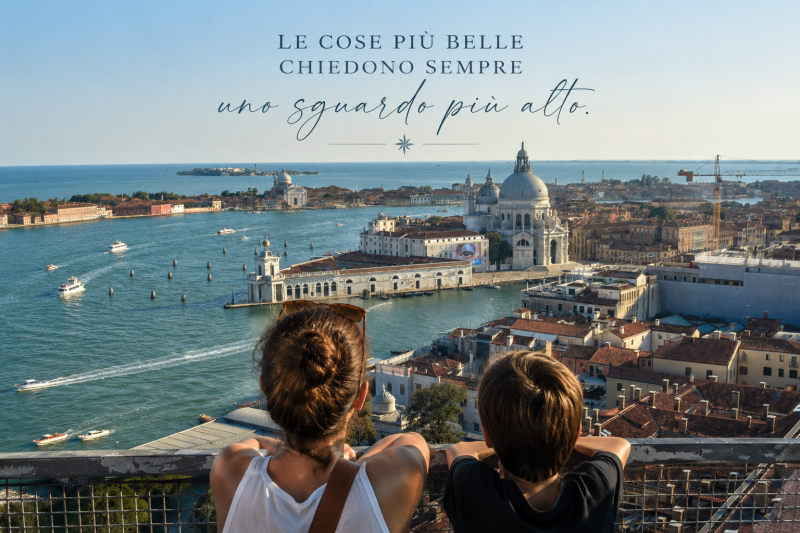
Le cose più belle chiedono sempre uno sguardo più alto
Ci sono ricordi che non diventano importanti perché sono stati perfetti. Lo diventano perché, da quel giorno, ci insegnano un modo diverso di guardare il mondo.
Ogni estate, prima di richiudere le valigie, Giorgio ed io facciamo sempre lo stesso gioco.
Ci facciamo due domande.
Qual è stato il ricordo più bello?
E quale pensiamo sia il punto di forza dell'altro?
Una specie di SWOT analysis in versione madre e figlio.
Con molta meno teoria.
E molta più vita.
Quest'anno ero convinta di conoscere la risposta.
Ci sono stati giorni che sembravano usciti da un romanzo d'avventura.
Un pallone regalato da Meir, diventato il nostro compagno di viaggio. Avremmo potuto comprarne un altro in qualsiasi città. Eppure era quel pallone. Lo abbiamo fatto passare due volte ai controlli aeroportuali, trattenendo il respiro ogni volta che spariva sul nastro trasportatore. Quando ricompariva dall'altra parte ci guardavamo sorridendo, come due complici che avevano appena portato a termine una missione segreta.
Ci sono state le montagne russe.
Lui rideva con gli occhi spalancati.
Io ridevo con gli occhi chiusi.
Perché ho scoperto che il coraggio di una madre non consiste nel non avere paura.
Consiste nel fidarsi della felicità di un figlio.
Ci sono stati incontri che dureranno il tempo di un'estate e forse, proprio per questo, resteranno per sempre.
Come Rosa.
Una bambina americana.
Suo padre mi raccontò che l'avevano chiamata così pensando a Rosa Luxemburg.
Mi colpì che un nome potesse custodire già un ideale.
Loro due, invece, decisero di cominciare dal gioco.
Avevano trovato un piccolo lanciatore che faceva salire nel cielo minuscoli punti luminosi.
Sembravano lucciole.
Le rincorrevano sopra Piazza San Marco come se la notte avesse deciso, per qualche minuto, di diventare bambina.
Quando arrivò il momento di salutarsi, Giorgio le disse con quella semplicità che noi adulti perdiamo troppo presto:
"Diventiamo amici... e io ti insegnerò una lingua che ancora non conosci: il siciliano."
Pensai che gli adulti passano la vita a imparare lingue per comunicare.
I bambini, invece, le usano per appartenersi.
Poi vennero le sere sul mare.
Quelle che sembrano allungarsi fino a confondersi con il cielo.
Con Luciano Maria raccoglievano conchiglie.
Dopo pochi minuti non erano più conchiglie.
Erano storie.
Una arrivava da un'isola lontanissima.
Un'altra custodiva il rumore del mare.
Una, dissero ridendo a due ragazze brasiliane, era addirittura la conchiglia dei Mondiali.
«Porta fortuna al Brasile.»
Le ragazze risero.
La comprarono.
Io sorrisi.
Perché avevo appena assistito a una lezione di creatività che nessun manuale di management riuscirà mai a spiegare così bene.
Le cose non acquistano valore per ciò che sono.
Lo acquistano per la storia che qualcuno è capace di raccontare.
Eppure...
quando arrivò il momento del nostro gioco, nessuno dei due scelse quei ricordi.
Scrivemmo la risposta senza mostrarcela.
Contammo fino a tre.
Girando il foglio nello stesso istante, scoppiammo a ridere.
Avevamo scritto entrambi la stessa identica cosa.
Il Campanile di Piazza San Marco.
Non Gardaland.
Non il mare.
Non il pallone.
Non le conchiglie.
Proprio il Campanile.
Fu allora che capii che il ricordo più bello non era il luogo.
Era il fatto che, senza esserci messi d'accordo, avessimo scelto la stessa prospettiva.
Da lassù Venezia sembrava respirare più lentamente.
Le calli non dividevano più.
I canali non erano confini.
Le persone diventavano piccoli punti in movimento.
E il nostro sguardo continuava ad andare oltre.
Verso quelle isole lontane che quasi nessuno osserva davvero.
«Secondo me laggiù vivono ancora i dinosauri.»
disse Giorgio.
«Non si sono mai estinti. Hanno semplicemente trovato un posto dove gli uomini non sono arrivati.»
Indicai un'altra isola.
«E lì?»
Ci pensò qualche secondo.
Poi rispose con assoluta convinzione.
«Lì vivono i fantasmi.»
«Perché proprio lì?»
Mi guardò sorridendo.
«Perché vogliono vivere tranquilli.
Senza gli esseri umani.»
Scoppiai a ridere.
Poi rimasi in silenzio.
Perché avevo la sensazione che quella risposta raccontasse molto più dei fantasmi.
Forse parlava anche di noi.
Di quanto, a volte, il silenzio sia una forma di pace.
Di quanto la fantasia continui a custodire domande che gli adulti hanno smesso di farsi.
Fu proprio lassù che capii una cosa di me.
Per anni ho creduto di amare i panorami.
Le ruote panoramiche.
I campanili.
Le terrazze.
I fari.
Pensavo fosse il desiderio di vedere più lontano.
Invece cercavo altro.
Cercavo uno sguardo.
Perché l'altezza non cambia il paesaggio.
Cambia il modo in cui impariamo ad abitarlo.
Mentre Giorgio costruiva il suo piccolo mondo fatto di amicizie improvvise, io avevo nello zaino Le vedove di Camus di Elena Rui.
Lo aprivo quando usciva con gli amici.
Quelle pagine mi accompagnavano senza interrompere il silenzio.
Mi ricordavano che ogni amore autentico, prima o poi, impara una lingua difficile.
Quella della libertà.
Non trattiene.
Custodisce.
Non possiede.
Accompagna.
L'ultima domanda del nostro gioco era ancora più bella.
«Qual è il punto di forza dell'altro?»
Gli dissi che la sua qualità più preziosa era essere accollativo, come diremmo a Roma.
In italiano diremmo accomodante.
Ma non è la stessa cosa.
Perché essere accollativo significa entrare in un luogo con rispetto.
Accogliere ciò che trovi.
Cambiare programma senza perdere il sorriso.
Fare spazio.
Gli dissi anche un'altra cosa.
Forse la più importante.
«Sai... oggi la cosa che ti pesa di più è salutare.
Lasciare una città.
Un amico.
Prendere un treno.
Ti sembra che ogni partenza porti via qualcosa.
Un giorno scoprirai che sarà il contrario.
Proprio questa capacità di sentire diventerà una delle tue più grandi ricchezze.
Perché avrai amici in tanti luoghi.
Forse amerai persone che parleranno lingue diverse dalla tua.
E capirai che chi entra davvero nella tua vita non se ne va quando prende un treno diverso dal tuo.
Continua a viaggiare con te.
Abita il tuo modo di guardare il mondo.»
Mi ascoltò senza interrompermi.
Poi sorrise.
E mi disse una frase che custodirò molto più a lungo di qualsiasi fotografia.
"Quando sto con te conosco persone provenienti da tante parti del mondo... e mi sembra che il mondo sia piccolo."
In quel momento ho pensato che forse tutta la mia ricerca, i libri, i viaggi, le lingue, l'università, cercassero da anni la stessa risposta.
Le Human Skills non nascono quando impariamo a parlare.
Nascono quando impariamo a guardare.
Oggi l'estate non è ancora finita.
Le valigie sono ancora aperte.
Ci aspettano nuove strade.
Nuovi incontri.
Nuove prospettive.
Ma se qualcuno mi chiedesse quale ricordo custodirò più a lungo, non parlerei di una città.
Parlerei di un Campanile.
Di un foglio girato nello stesso istante.
Di due risposte identiche.
E di quella meravigliosa scoperta che, forse, è il dono più grande che una madre possa ricevere.
Accorgersi che, senza averglielo insegnato, suo figlio ha imparato a riconoscere la stessa bellezza.
Perché le cose più belle non chiedono di essere raggiunte.
Chiedono soltanto uno sguardo abbastanza alto da riconoscerle.
E forse l'amore, quello che resta, non è altro che questo.
Continuare a salire.
Non per sentirsi più vicini al cielo.
Ma per riuscire, almeno ogni tanto, a guardare il mondo con gli occhi dell'altro.
V.C
The Most Beautiful Things Always Ask for a Higher Perspective
Some memories stay with us not because they were perfect, but because they quietly teach us a new way of looking at the world.
Every summer, before closing our suitcases, Giorgio and I play the same game.
We ask each other two questions.
What was the most beautiful moment?
And:
What do you think is the other person's greatest strength?
A sort of SWOT analysis between a university professor and a ten-year-old boy.
Less theory.
Much more life.
This year, I was convinced I already knew his answer.
There had been days that could have filled an entire summer on their own.
A football given to Giorgio by our friend Meir, carefully protected throughout the journey. We carried it through airport security twice, holding our breath every time it disappeared onto the conveyor belt. Whenever it came out on the other side, we smiled at each other like two conspirators who had just completed a secret mission.
There had been roller coasters.
He laughed with his eyes wide open.
I laughed with mine tightly closed.
Because I have discovered that a mother's courage has very little to do with being fearless.
It has everything to do with trusting the happiness of your child.
There had been unexpected encounters.
Children possess a gift that adults slowly forget.
They never ask,
"Where are you from?"
They simply ask,
"Do you want to play?"
One evening we met Rosa, an American girl.
Her father told me she had been named after Rosa Luxemburg.
I was struck by the thought that some names already carry history within them.
The children, however, began somewhere much simpler.
With a tiny toy launcher that sent glowing lights into the evening sky.
For a few magical minutes, Piazza San Marco seemed filled with fireflies.
When it was time to say goodbye, Giorgio looked at Rosa and said,
"Let's be friends... and I'll teach you a language you don't know yet. Sicilian."
It made me smile.
Adults spend years learning languages in order to communicate.
Children use them to belong.
There were long evenings by the sea.
Together with Luciano Maria, Giorgio collected shells.
Only they never remained shells for very long.
Within minutes they had become stories.
One had crossed an ocean.
Another still carried the sound of the waves.
One, they proudly explained to two Brazilian girls, was the World Cup shell.
"It brings Brazil good luck."
The girls laughed.
Then they bought it.
And I realised that children instinctively understand something many entrepreneurs spend their lives trying to learn.
Objects are rarely what people fall in love with.
Stories are.
And yet...
when our game finally began, neither of us chose any of those memories.
We wrote our answers without showing each other.
Counted to three.
Turned our papers over.
And burst into laughter.
We had written exactly the same words.
The Bell Tower of St. Mark's Square.
Not the roller coasters.
Not the sea.
Not the football.
Not the shells.
The Bell Tower.
At that precise moment I realised that the most beautiful memory wasn't the place itself.
It was discovering that, without saying a word, we had both recognised beauty in exactly the same place.
From up there Venice seemed to breathe more slowly.
The narrow streets no longer separated people.
The canals looked less like borders and more like threads weaving everything together.
Then our eyes wandered further away.
Toward the tiny islands resting quietly in the lagoon.
The ones almost nobody notices.
"I think dinosaurs still live over there," Giorgio said.
"They never became extinct. They simply found a place where humans never arrived."
I pointed toward another island.
"And there?"
He thought for a moment.
"Ghosts."
"Why ghosts?"
He answered with complete seriousness.
"Because they want to live in peace... without human beings."
I laughed.
Then I fell silent.
Because somehow that answer wasn't only about ghosts.
It was about the strange innocence that allows children to imagine the impossible without ever sounding naïve.
Standing there, I suddenly understood something about myself.
For years I believed I loved panoramic views.
Ferris wheels.
Bell towers.
Lighthouses.
Rooftops.
I thought I was searching for landscapes.
I wasn't.
I was searching for perspective.
Because height does not change the world.
It changes the way we see it.
While Giorgio was building his own little universe of friendships and discoveries, I always carried a book in my bag.
Camus' Widows by Elena Rui.
I would open it whenever he disappeared with his new friends.
Those pages became silent companions.
They reminded me that every mature form of love eventually learns one difficult language.
Freedom.
Love does not hold on.
It accompanies.
It does not possess.
It protects.
Then came the second question of our little ritual.
"What is the other person's greatest strength?"
I told Giorgio that his greatest gift was something we say in Roman dialect: accollativo.
There is no perfect English translation.
Perhaps adaptable comes closest.
But it means much more.
It is the ability to arrive somewhere unfamiliar without trying to change it.
To make space.
To welcome what is different.
To feel at home without asking the world to become smaller.
Then I told him something I hope he will remember one day.
"Right now," I said, "the hardest part for you is saying goodbye.
Leaving a city.
Leaving new friends.
Watching people take different trains.
One day you will realise that this is actually one of your greatest strengths.
Because you will have friends in many countries.
Perhaps people you love who speak different languages.
And you will discover something beautiful.
People who truly enter your life never leave when they board a different train.
They continue travelling inside you.
They become part of the way you see the world."
He listened quietly.
Then he smiled.
And answered with a sentence I know I will carry far longer than any photograph.
"When I'm with you, I meet people from all over the world... and it makes me feel like the world is actually very small."
At that moment I realised that perhaps everything I have studied for years—education, leadership, Human Skills, languages, research—had always been searching for the same truth.
Human Skills do not begin when we learn how to speak.
They begin when we learn how to see.
Today our summer is not over yet.
Our suitcases are still open.
New journeys are waiting.
New encounters.
New perspectives.
But if someone asked me which memory I will carry forever, I would not answer with the name of a city.
I would answer with a bell tower.
Two pieces of paper.
Two identical answers.
And the extraordinary discovery that, perhaps, the greatest gift a mother can receive is not teaching her child how to see beauty...
But realising that, one day, he has quietly learned to recognise the very same beauty on his own.
Because the most beautiful things never ask to be possessed.
They simply ask for a higher perspective.
And perhaps love has always been just that.
Not holding on to one another.
But helping each other climb high enough to discover that, without ever planning it, we are still looking toward the same horizon.
V.C.
Researching the human, one story at a time.
Aggiungi commento
Commenti