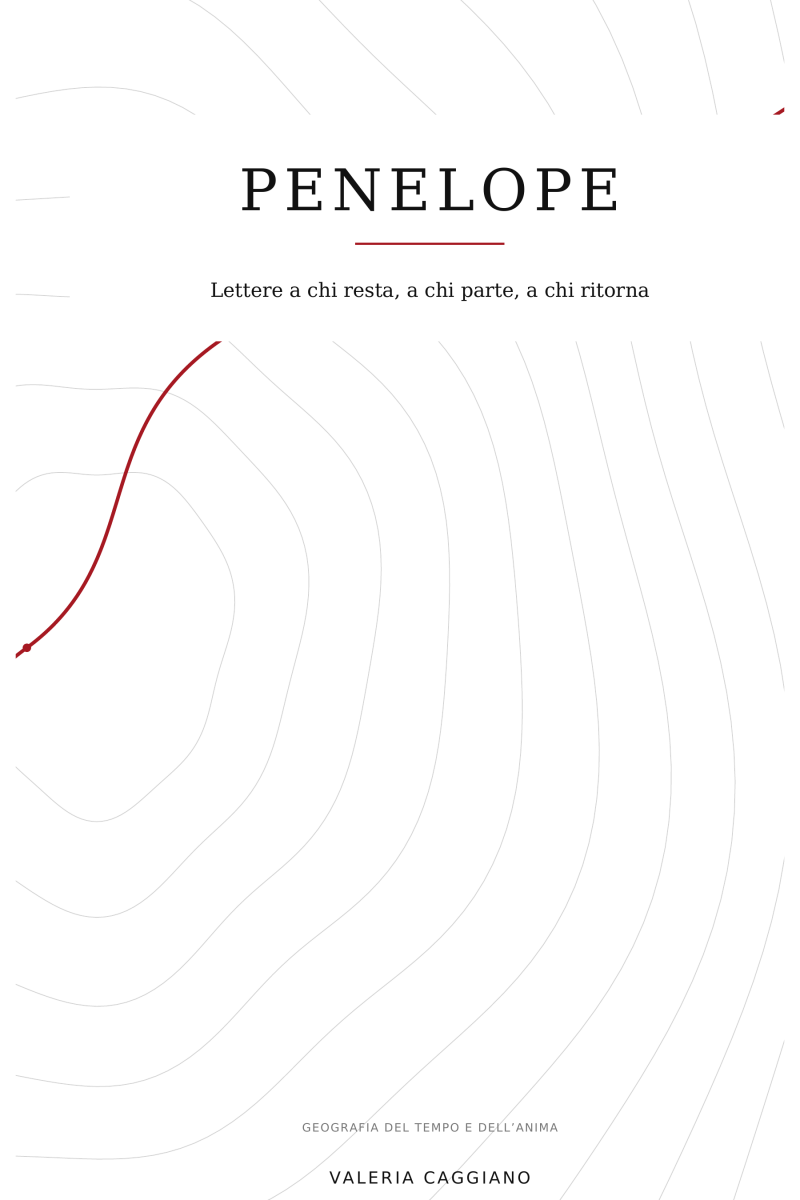
Penelope prende finalmente la parola
Perché, dopo quasi tremila anni, ho scelto di scriverle una voce.
"Ci sono libri che nascono da un'idea. Altri da una ricerca. E poi ci sono libri che nascono da una domanda così ostinata da non lasciarti più in pace."
Questo libro è nato così.
Per molto tempo ho studiato Penelope come tutti noi abbiamo imparato a conoscerla: attraverso Omero, attraverso la tradizione classica, attraverso gli occhi di chi, nei secoli, ha cercato di interpretarne il silenzio.
Era la moglie fedele.
La donna che attende.
La regina di Itaca.
La tessitrice.
Il simbolo della pazienza.
Ma, pagina dopo pagina, mentre leggevo Omero, Aristotele, María Zambrano e le interpretazioni di filologi, filosofi e studiose contemporanee, una domanda è diventata sempre più insistente.
E se Penelope avesse potuto scrivere?
Non essere raccontata.
Non essere interpretata.
Scrivere.
Da quel momento il progetto ha smesso di essere un semplice studio sull'Odissea.
È diventato un ascolto.
Quando la ricerca incontra la letteratura
Chi mi conosce sa che da anni mi occupo di educazione, Human Skills, leadership umanistica e processi di formazione.
La ricerca mi ha insegnato una cosa fondamentale: i grandi classici non sopravvivono perché appartengono al passato.
Sopravvivono perché continuano a generare domande.
L'Odissea non parla soltanto del ritorno di Ulisse.
Parla del tempo.
Dell'identità.
Dell'educazione.
Della cura.
Della responsabilità.
Dell'amore.
Dell'assenza.
E soprattutto della straordinaria capacità dell'essere umano di continuare a costruire senso anche quando il futuro è incerto.
È qui che Penelope è entrata nella mia vita di ricercatrice.
Non come un personaggio.
Ma come una metafora educativa.
La Penelope che non avevo mai incontrato
Durante la scrittura ho scoperto una donna molto diversa da quella che spesso immaginiamo.
Non una figura immobile.
Ma una donna che pensa.
Che governa.
Che educa Telemaco.
Che protegge una comunità.
Che prende decisioni ogni giorno senza avere la certezza che Ulisse tornerà davvero.
La sua attesa non è passività.
È responsabilità.
Il suo telaio non è un rifugio.
È una forma di resistenza.
Il suo silenzio non è assenza.
È uno spazio in cui il pensiero continua a maturare.
Forse è proprio questo che rende Penelope così contemporanea.
Perché un epistolario
Avrei potuto scrivere un saggio.
Oppure un romanzo.
Ho scelto invece un epistolario.
Perché la lettera è il luogo della verità.
Non cerca di convincere.
Non pretende di avere ragione.
Non insegna.
Condivide.
Ogni lettera diventa un dialogo.
Con Ulisse.
Con Telemaco.
Con Antinoo.
Con sé stessa.
Ma, soprattutto, con ciascuno di noi.
Una conversazione lunga tremila anni
Scrivere questo libro ha significato entrare in dialogo con molte voci.
Con Omero.
Con Aristotele.
Con María Zambrano, che ha saputo insegnarmi il valore del pensiero poetico.
Con Luigina Mortari, che ha restituito alla cura la dignità di un sapere.
Con Martha Nussbaum, Simone Weil, Edith Stein e con le tante donne che hanno abitato il confine tra filosofia, poesia ed esperienza.
Non ho voluto citarle per costruire un apparato accademico.
Le ho cercate perché ogni grande libro nasce da una conversazione.
E nessuna conversazione attraversa il tempo da sola.
Penelope parla ancora di noi
Mentre scrivevo, mi sono resa conto che Penelope non appartiene soltanto all'antichità.
Abita le nostre case.
Le nostre scuole.
I luoghi di lavoro.
Le famiglie.
Le donne che tengono insieme il quotidiano mentre il mondo corre.
Gli uomini che imparano che la forza non coincide con il dominio.
Gli educatori che scelgono di custodire invece di controllare.
Chiunque abbia imparato che esistono attese che non impoveriscono, ma trasformano.
Per questo il libro non parla soltanto di Penelope.
Parla dell'umano.
Un libro che continua a camminare
Oggi questo libro è finalmente tra le mani dei suoi lettori.
È un momento che accolgo con gratitudine, ma anche con una certa emozione.
Perché ogni libro pubblicato smette di appartenere soltanto a chi lo ha scritto.
Inizia il suo viaggio.
Entrerà nelle case.
Nelle biblioteche.
Forse nelle aule universitarie.
Spero anche nei gruppi di lettura, nelle conversazioni tra amiche, nelle scuole, nei luoghi dove i classici possono tornare a essere strumenti per comprendere il presente.
Se anche una sola lettrice, chiudendo l'ultima pagina, sentirà di avere trovato parole nuove per raccontare la propria storia, allora questo lungo dialogo con Penelope avrà trovato il suo senso.
Perché, in fondo, non ho scritto questo libro per restituire la parola a un personaggio del mito.
L'ho scritto perché credo che i grandi classici continuino a educarci quando smettiamo di considerarli opere del passato e iniziamo ad ascoltarli come compagni di viaggio.
E forse Penelope, oggi più che mai, aveva ancora qualcosa da dirci.
Valeria Caggiano
Ricercatrice dell'umano, docente universitaria e autrice.
📖 Penelope. Lettere di una donna che attraversa il tempo è ora disponibile su Amazon.
Se questo articolo ha suscitato una domanda, una memoria o un'emozione, spero che il libro possa accompagnarti nel dialogo con una delle figure femminili più straordinarie della letteratura universale.
Penelope Finally Finds Her Voice
Why, after almost three thousand years, I chose to give her one.
"Some books begin with an idea. Others with research. And then there are books born from a question so persistent that it refuses to let you go."
This book was born that way.
For a long time, I studied Penelope as most of us first encounter her: through Homer, through the classical tradition, through the eyes of those who, across the centuries, have sought to interpret her silence.
She was the faithful wife.
The woman who waited.
The Queen of Ithaca.
The weaver.
The symbol of patience.
Yet, as I immersed myself in Homer, Aristotle, María Zambrano, and the work of classicists, philosophers, educators, and contemporary scholars, one question gradually became impossible to ignore.
What if Penelope had been able to write?
Not to be narrated.
Not to be interpreted.
But to write.
From that moment on, this project ceased to be simply a study of the Odyssey.
It became an act of listening.
When Research Meets Literature
Those who know my work are aware that my research has long focused on education, Human Skills, humanistic leadership, and lifelong learning.
Research has taught me one essential truth: the great classics do not survive because they belong to the past.
They endure because they continue to generate new questions.
The Odyssey is not merely the story of Odysseus' return home.
It is a story about time.
Identity.
Education.
Care.
Responsibility.
Love.
Absence.
And, above all, about the extraordinary human capacity to create meaning even when the future remains uncertain.
It is here that Penelope entered my life—not merely as a literary character, but as an educational metaphor.
The Penelope I Had Never Met
Throughout the writing process, I discovered a Penelope very different from the one we often imagine.
Not a passive figure.
But a woman who thinks.
Who governs.
Who educates Telemachus.
Who protects an entire community.
Who makes difficult decisions every single day without knowing whether Odysseus will ever return.
Her waiting is not passivity.
It is responsibility.
Her loom is not a refuge.
It is a form of resistance.
Her silence is not emptiness.
It is the space where thought continues to mature.
Perhaps this is what makes Penelope so profoundly contemporary.
Why an Epistolary Novel?
I could have written an academic essay.
I could have written a historical novel.
Instead, I chose the epistolary form.
Because letters are places of truth.
They do not seek to persuade.
They do not claim certainty.
They do not teach.
They share.
Every letter becomes a dialogue.
With Odysseus.
With Telemachus.
With Antinous.
With herself.
But, above all, with each of us.
A Conversation Across Three Thousand Years
Writing this book meant entering into conversation with many voices.
With Homer.
With Aristotle.
With María Zambrano, whose poetic philosophy taught me to inhabit silence as the birthplace of thought.
With Luigina Mortari, who restored care to its dignity as a form of knowledge.
With Martha Nussbaum, Simone Weil, Edith Stein, and many other women whose writings inhabit the fertile space where philosophy, poetry, and lived experience meet.
I did not bring these voices into the book to construct an academic apparatus.
I sought them because every meaningful book emerges from a conversation.
And no conversation worthy of the human experience is ever carried by a single voice.
Penelope Still Speaks to Us
As I wrote, I realized that Penelope does not belong solely to ancient Greece.
She lives in our homes.
In our schools.
In our workplaces.
Within our families.
She lives in women who quietly hold together the fabric of everyday life while the world rushes forward.
She lives in men who discover that strength is not the same as domination.
She lives in educators who choose to nurture rather than control.
She lives in anyone who has learned that some forms of waiting do not diminish us—they transform us.
For this reason, this book is not only about Penelope.
It is about being human.
A Book That Begins a New Journey
Today, this book has finally found its readers.
I welcome this moment with deep gratitude—and with a certain emotion.
Because once a book is published, it no longer belongs only to the person who wrote it.
Its own journey begins.
It will enter homes.
Libraries.
Perhaps university classrooms.
I hope it will also find its place in reading circles, conversations among friends, and educational settings where the classics continue to illuminate contemporary life.
If even one reader closes the final page feeling they have discovered new words to understand their own story, then this long dialogue with Penelope will have fulfilled its purpose.
Because, ultimately, I did not write this book simply to give voice to a mythological figure.
I wrote it because I believe that the great classics continue to educate us the moment we stop treating them as relics of the past and begin welcoming them as companions for the journey.
And perhaps, now more than ever,
Penelope still has something to tell us.
Valeria Caggiano
Researcher of the Human Experience, Associate Professor, and Author.
Now Available
📖 Penelope – Letters of a Woman Across Time is now available on Amazon.
If this article has awakened a question, a memory, or an emotion, I hope this book will accompany you in discovering one of the most extraordinary female voices in world literature—not as a figure frozen in myth, but as a companion for our own journey through love, responsibility, education, and hope.
Aggiungi commento
Commenti