I libri di poesia che ho scelto di portare con me
Ci sono oggetti che possediamo.
E poi ci sono oggetti che ci abitano.
I miei libri di poesia appartengono alla seconda categoria.
Li colleziono da quando avevo quindici anni.
Li ho comprati nelle librerie delle città visitate per la prima volta. Nei mercatini dove si trovano cose che nessuno cerca più. Nelle bancarelle di provincia. Nei pomeriggi in cui avevo pochi soldi e molte domande.
Alcuni mi sono stati regalati.
Altri li ho inseguiti.
Altri ancora mi hanno trovato da soli.
Li ho portati con me nei traslochi, nei cambi di casa, nelle partenze e nei ritorni.
Hanno attraversato città, stagioni, amori, delusioni, rinascite.
E sono ancora qui.
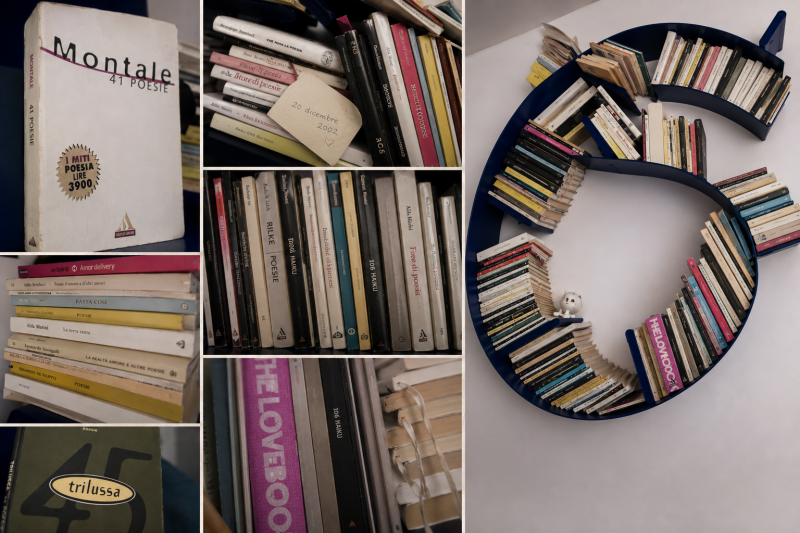
Qualche giorno fa ne ho preso in mano uno.
Sulla copertina c'era ancora il prezzo.
3.900 lire.
Mi sono fermata a sorridere.
Perché in quel momento ho capito che non stavo guardando un libro.
Stavo guardando una ragazza.
La ragazza che ero stata.
Quella che entrava in libreria e usciva con una raccolta di Montale o di Trilussa sotto il braccio.
Quella che pensava che la poesia potesse spiegare il mondo.
O almeno renderlo un po' più comprensibile.
Per un periodo ho creduto che la poesia sarebbe diventata il mio mestiere.
Mi affascinava la poetry therapy.
La possibilità che le parole potessero curare.
Che una poesia letta al momento giusto potesse fare quello che spesso non riescono a fare i consigli.
Avevo immaginato percorsi diversi.
La psicologia.
La psicoterapia.
L'America.
I libri.
Le persone.
La cura.
Poi la vita, come fa sempre, ha scritto una storia diversa.
Sono diventata professoressa.
Ricercatrice.
Formatrice.
Mi occupo di leadership, educazione, organizzazioni e sviluppo umano.
Ma guardando oggi quella libreria, mi accorgo che forse non mi sono mai allontanata davvero dalla poesia.
Ho semplicemente imparato a viverla in altre forme.
C'è chi pensa che la poesia serva a scrivere versi.
Io non lo credo.
Credo che la poesia serva a guardare.
A vedere quello che spesso sfugge.
A fermarsi.
Ad ascoltare.
A dare un nome alle cose che sentiamo ma non sappiamo spiegare.
In un tempo che ci chiede continuamente di essere veloci, efficienti, performanti, la poesia continua a ricordarmi che la vita accade altrove.
Accade nelle pause.
Nei dettagli.
Nei silenzi.
Nelle persone.
Nelle relazioni.
Nelle parole che scegliamo.
E anche in quelle che decidiamo di non dire.
Qualche anno fa ho comprato una libreria.
La desideravo da tempo.
Blu.
Essenziale.
Disegnata come una grande lettera G.
Quando è arrivata, qualcuno mi ha chiesto perché avessi scelto proprio quella.
Non ho risposto subito.
Perché la verità è che quella G aveva molti significati.
La G di Giorgio.
Naturalmente.
Ma anche la G di gratitudine.
Di gentilezza.
Di generatività.
Di crescita.
Parole che oggi chiamiamo soft skills.
Parole che i poeti raccontano da secoli.
Lì dentro ho sistemato i miei libri.
Montale.
Merini.
Rilke.
Gli Haiku.
Trilussa.
E tanti altri.
Volumi consumati dal tempo e dall'affetto.
Libri che non valgono nulla sul mercato e moltissimo nella mia vita.
Ogni tanto ne apro uno a caso.
Tra le pagine trovo biglietti dimenticati.
Date.
Sottolineature.
Versioni precedenti di me stessa.
E mi accorgo che la poesia non mi ha insegnato a scrivere.
Mi ha insegnato ad abitare il mondo.
Forse è per questo che continuo a credere che l'educazione non sia soltanto trasmissione di conoscenze.
Che la leadership non sia soltanto capacità di guidare.
Che il successo non sia soltanto raggiungere obiettivi.
Le cose più importanti che ho imparato non le ho trovate nei manuali.
Le ho trovate nei libri che ho scelto di non lasciare indietro.
Oggi insegno agli studenti parole come leadership, soft skills, intelligenza emotiva, resilienza.
Ma se devo essere sincera, credo che tutto sia iniziato molto prima.
In una libreria.
Con un libro di poesie comprato in lire.
E una ragazza di quindici anni che ancora non lo sapeva, ma stava già imparando a diventare se stessa.
Valeria Caggiano
Professoressa Universitaria | Ricercatrice Internazionale | Humanistic Leadership
Ricerca, Educazione, Soft Skills, Intelligenza Emotiva e Trasformazione Human-Centered
The Poetry Books I Chose to Carry With Me
Why being poetic is not about writing poems. It is about remaining human.
There are objects we own.
And then there are objects that become part of us.
My poetry books belong to the second category.
I have been collecting them since I was fifteen years old.
I found them in bookshops, flea markets, second-hand stalls, and during travels that now feel like another life.
Some were gifts.
Some I searched for.
Others simply found me.
Over the years, they have crossed cities, homes, seasons, relationships, departures and returns.
And somehow, they are still here.
A few days ago, I picked up an old copy of Montale.
The price sticker was still there.
3,900 Italian lire.
I smiled.
Because I suddenly realised that I was not looking at a book.
I was looking at a girl.
The girl I used to be.
The one who would walk into a bookshop and leave carrying a collection of poems instead of something more practical.
The one who believed poetry could explain the world.
Or at least make it a little more understandable.
For a period of my life, I thought poetry would become my profession.
I was fascinated by poetry therapy.
By the idea that words could heal.
That a poem, encountered at the right moment, could sometimes do what advice could not.
I imagined different paths.
Psychology.
Psychotherapy.
Studying in the United States.
Working with people through stories and language.
Life, as it often does, chose another route.
I became a university professor.
A researcher.
An educator.
Today I work on leadership, education, soft skills and human development.
And yet, looking at my poetry shelf, I realise that I never truly left poetry behind.
I simply learned to live it differently.
Many people think poetry is about writing verses.
I do not.
I think poetry is about learning how to see.
To notice what others overlook.
To listen carefully.
To stay with complexity.
To recognise beauty, even when it appears quietly.
In a world obsessed with speed, performance and efficiency, poetry continues to remind me that life happens elsewhere.
In pauses.
In details.
In relationships.
In silence.
In the words we choose.
And sometimes, in the words we leave unsaid.
A few years ago, I bought a bookshelf I had wanted for a very long time.
Blue.
Minimal.
Designed in the shape of a large letter G.
When it arrived, someone asked me why I had chosen that particular shape.
The truth is that the answer was never simple.
It is the G of Giorgio.
Of course.
But it is also the G of gratitude.
Of gentleness.
Of growth.
Of generosity.
Words that today we often describe as soft skills.
Words that poets have been teaching for centuries.
This is where my books now live.
Montale.
Merini.
Rilke.
Haiku.
Trilussa.
And many others.
Books worn by time and affection.
Books that may not be worth much on the market, but are priceless in my life.
Every now and then I open one at random.
Inside I find forgotten notes.
Train tickets used as bookmarks.
Dates.
Annotations.
Earlier versions of myself.
And I realise that poetry never taught me how to write.
It taught me how to inhabit the world.
Perhaps this is why I continue to believe that education is not only the transmission of knowledge.
That leadership is not only the ability to guide.
That success is not only the achievement of goals.
The most important lessons I have learned were never found in manuals.
They were found in the books I chose not to leave behind.
Today I teach concepts such as leadership, emotional intelligence, resilience and soft skills.
But if I am completely honest, I believe it all began much earlier.
In a small bookshop.
With a book of poems purchased in Italian lire.
And a fifteen-year-old girl who did not know it yet, but was already learning how to become herself.
Valeria Caggiano
University Professor | International Researcher | Humanistic Leadership
Research, Education, Emotional Intelligence, Soft Skills and Human-Centered Transformation
Human Skills & Real Life
Stories, leadership, education, poetry and the human skills that shape who we become.